ETM Muninn™
Your company's accumulated insights, practices, decision guidelines, and policies live in a memory system you own and control, not inside any one AI vendor.
Our open-source projects work with all major enterprise-grade AI systems. Support and maintenance services are available to our enterprise customers.
Your company's accumulated insights, practices, decision guidelines, and policies live in a memory system you own and control, not inside any one AI vendor.
Deeper reasoning across many sources before any recommendation reaches you.
Switch or add AI systems anytime and bring your agents, workflows, and knowledge with you.
Keeps your people and your AI systems aligned on the same goals, plans, and decisions.
Test each new AI system before you trust it, so changes don't break what works.
Links outcomes to their causes, so every result teaches your organization how to improve.
Your company's memory, owned by your company
Your company's accumulated insights, practices, decision guidelines, and policies live in a memory system you own and control, not inside any one AI vendor.
Secure deep context memory layer that can be shared across multiple agents, agentic workflows, and harness systems.
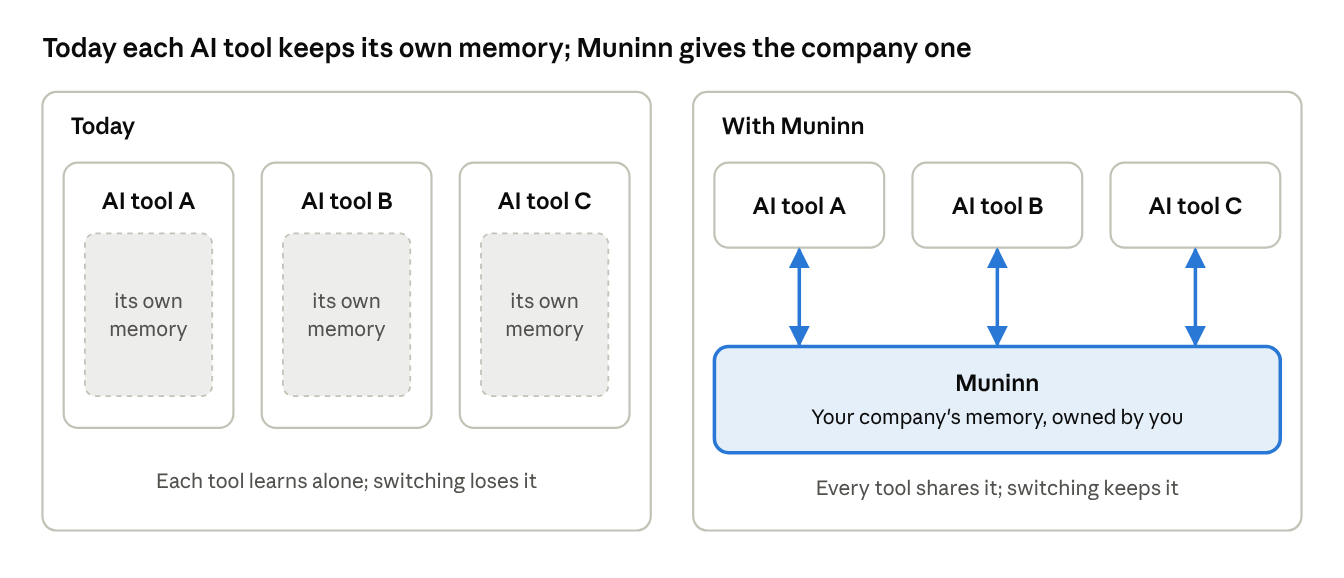
Every company builds up hard-won knowledge: what it has learned, how it works, how it makes decisions, and the rules it holds itself to. As AI takes on more of that work, the knowledge ends up scattered across AI tools. Each tool learns separately, forgets when you switch, and keeps what it learned inside the vendor's walls.
The result is AI that repeats old mistakes, gives different answers to the same question, and has to be retaught every time the company changes tools.
Muninn gives your company one memory that every AI system can draw on. Your people and your AI agents add to it as they work. Each AI system gets the right knowledge at the right moment, and only the knowledge it is allowed to see.
Because the memory belongs to you, you can add or change AI systems without starting over. The knowledge stays with you after the engagement ends.
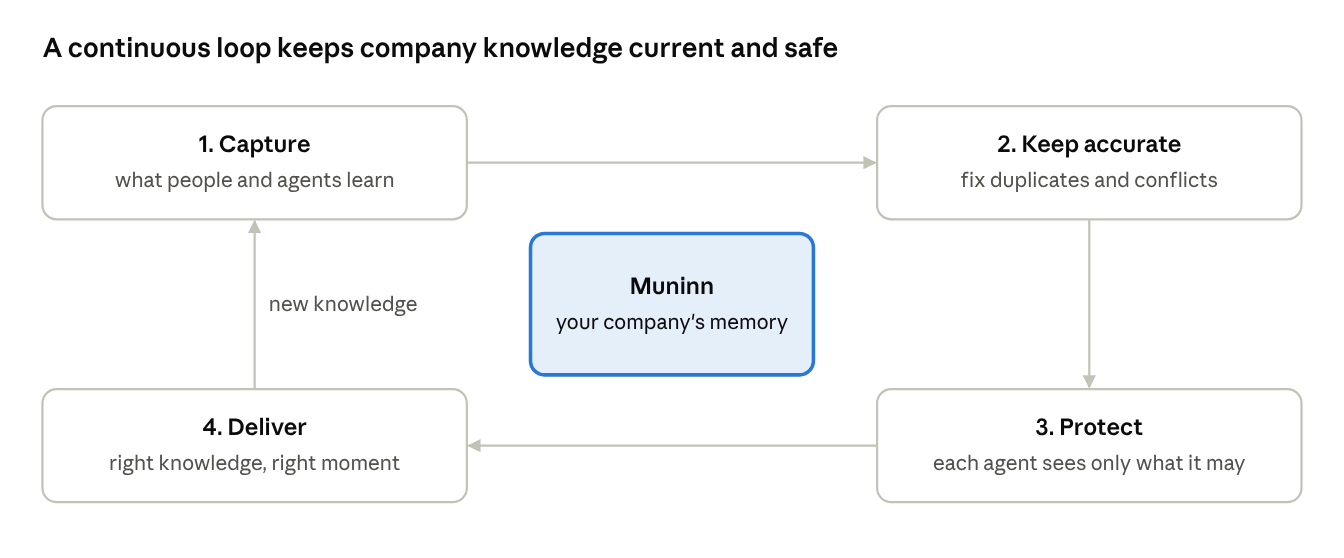
In Norse mythology, Muninn ("memory") is one of Odin's two ravens. Each day it flies across the world and returns with what it has seen.
Your company's thinking, applied before you decide
Deeper reasoning across many sources before any recommendation reaches you.
Advanced reasoning and multi-context deliberation capabilities.
AI systems now answer questions that once went to analysts and advisors, and they answer in seconds. An answer can rest on whatever sources were at hand, and a confident tone can hide thin evidence.
The perspectives a sound decision needs, from customers, finance, operations and risk, rarely meet before an answer lands on your desk. Disagreement gets averaged away, and the company's own way of thinking about its business is left out.
Huginn gives you an answer you can check line by line.
Huginn turns a decision question into a recommendation you can check. It reasons over your company's knowledge in Muninn from several perspectives, using your own mental models and rules of thumb before generic ones.
Each perspective weighs the options on its own evidence before they compare notes, and the leading option is challenged before you see it. You get a brief that shows the options, the evidence, the disagreements and how confident Huginn is. Huginn recommends; your people decide.
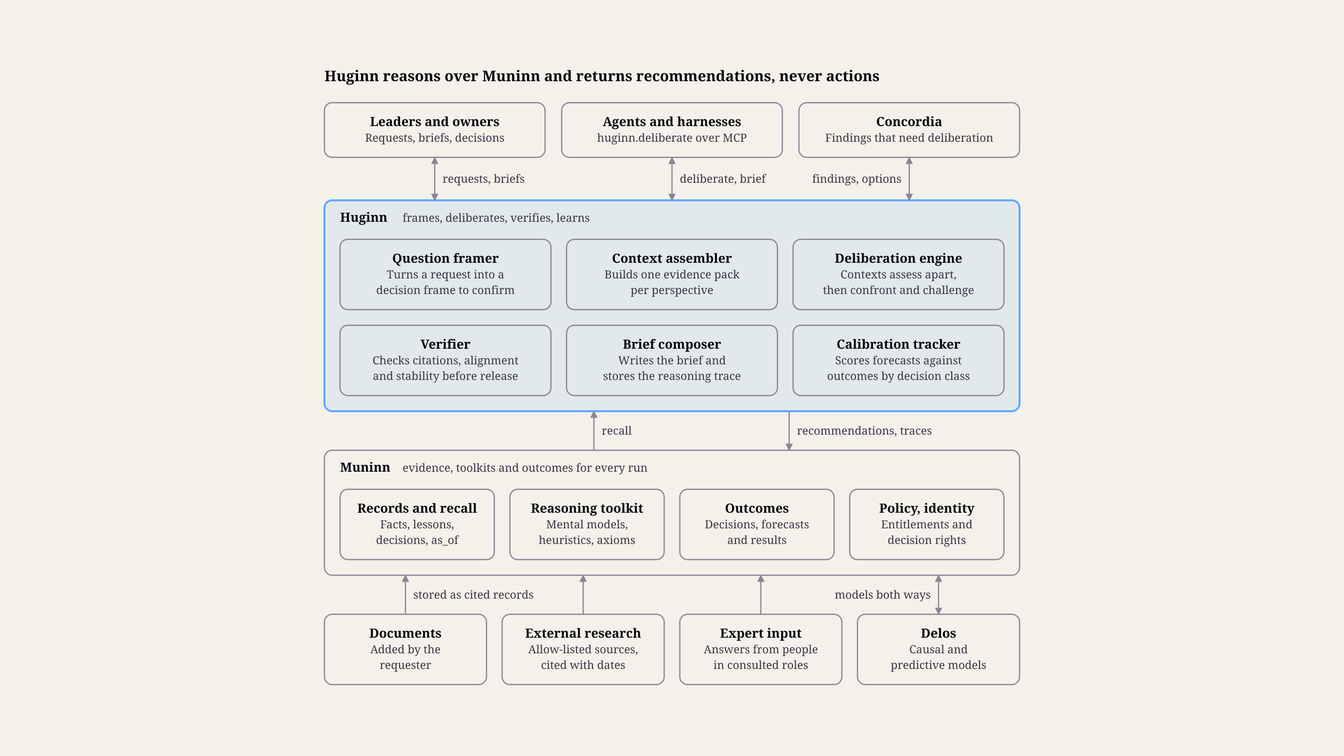
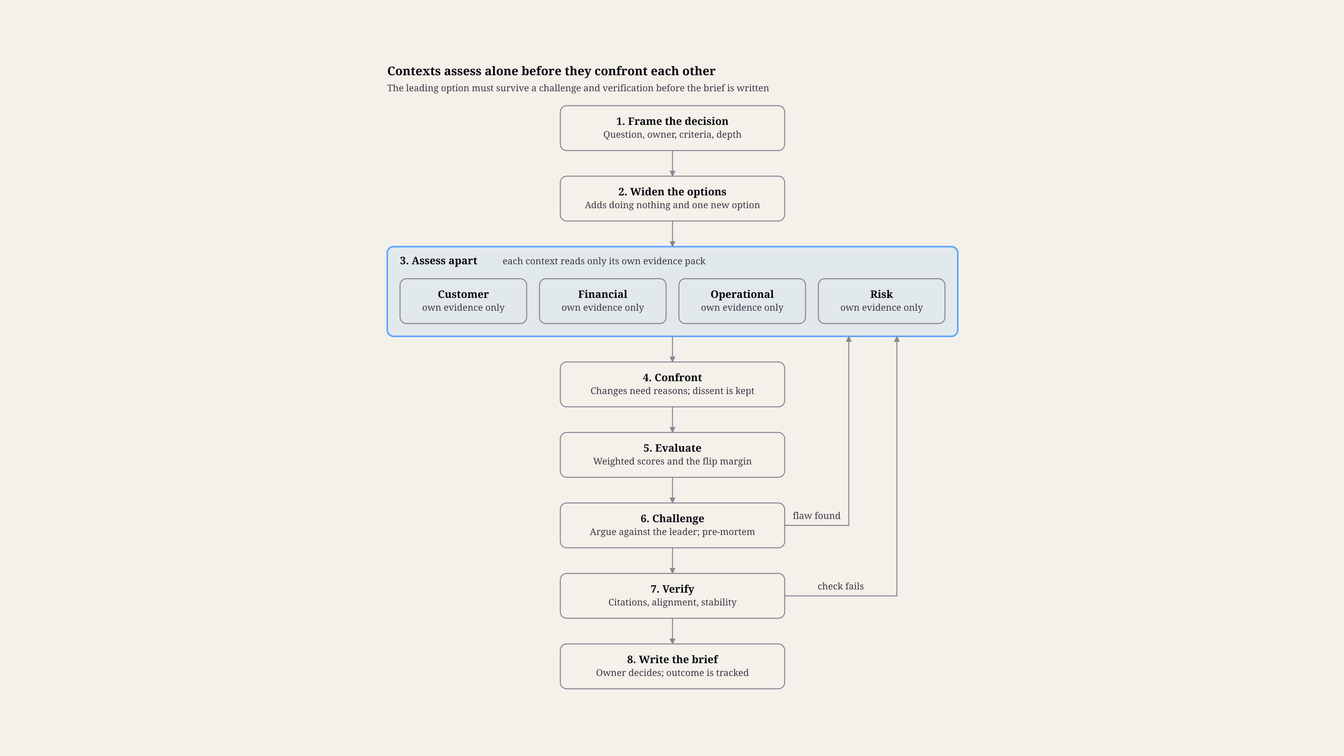
In Norse mythology, Huginn ("thought") is the other of Odin's two ravens. Each day it flies out over the world, as Muninn does, and returns with what it has learned. ETM Huginn thinks through what Muninn remembers, so every recommendation draws on both.
Your company's agents, free to move between systems
Switch or add AI systems anytime and bring your agents, workflows, and knowledge with you.
Harvest and migrate agents and agentic workflows across users and systems.
Teams now build agents and workflows inside several AI systems at once, often without anyone keeping track. Each one is shaped by the system it was built in, from how its instructions are written to which tools it can call.
When a company wants to switch systems, or add one, that work is hard to find and harder to move. Too often the choice comes down to starting over or staying where you are.
Pleiades finds the agents, assistants, skills and workflows your people have built across your AI systems. It keeps one vendor-neutral definition of each in Muninn, whether the source organizes its work around named agents or workflows.
When you switch or add a system, Pleiades carries over what it can, rebuilds what it must and lists anything a person has to redo. Your knowledge moves once, into Muninn, and every system reaches it there. People switch over only after the new copy passes the original's tests.
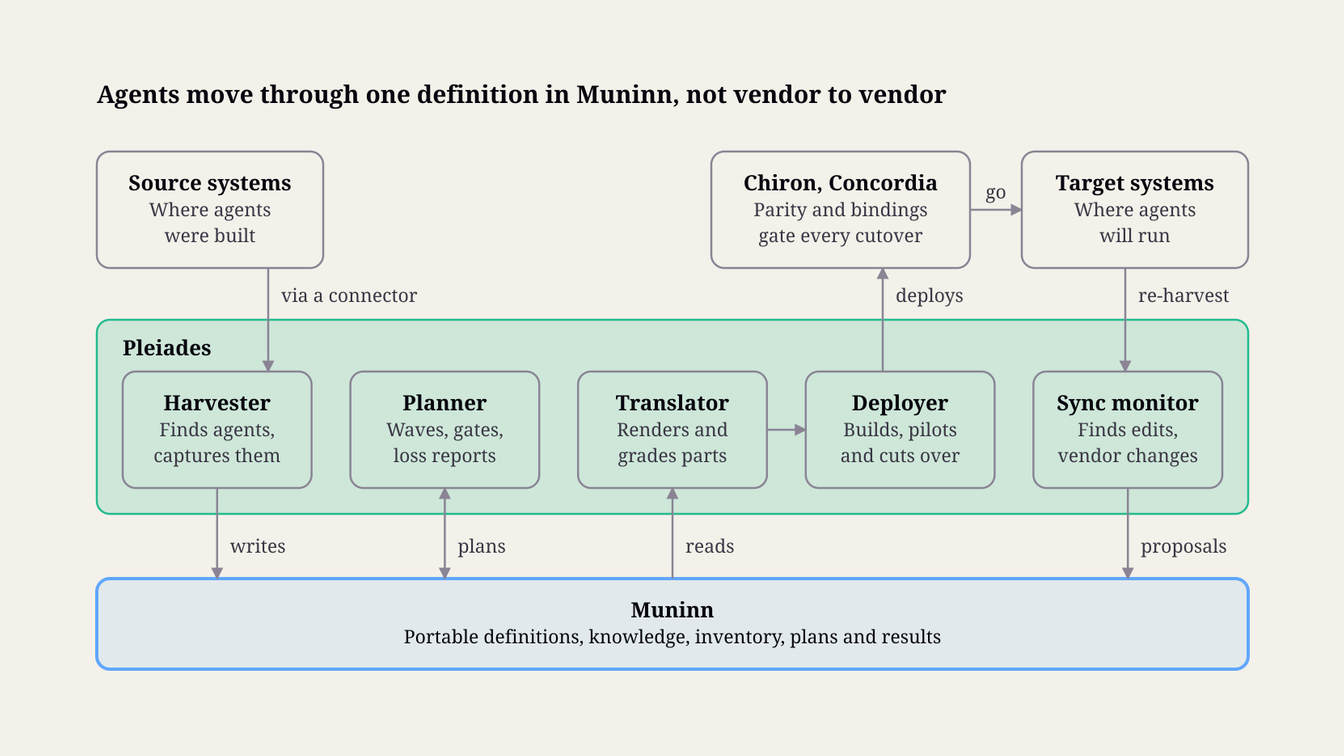
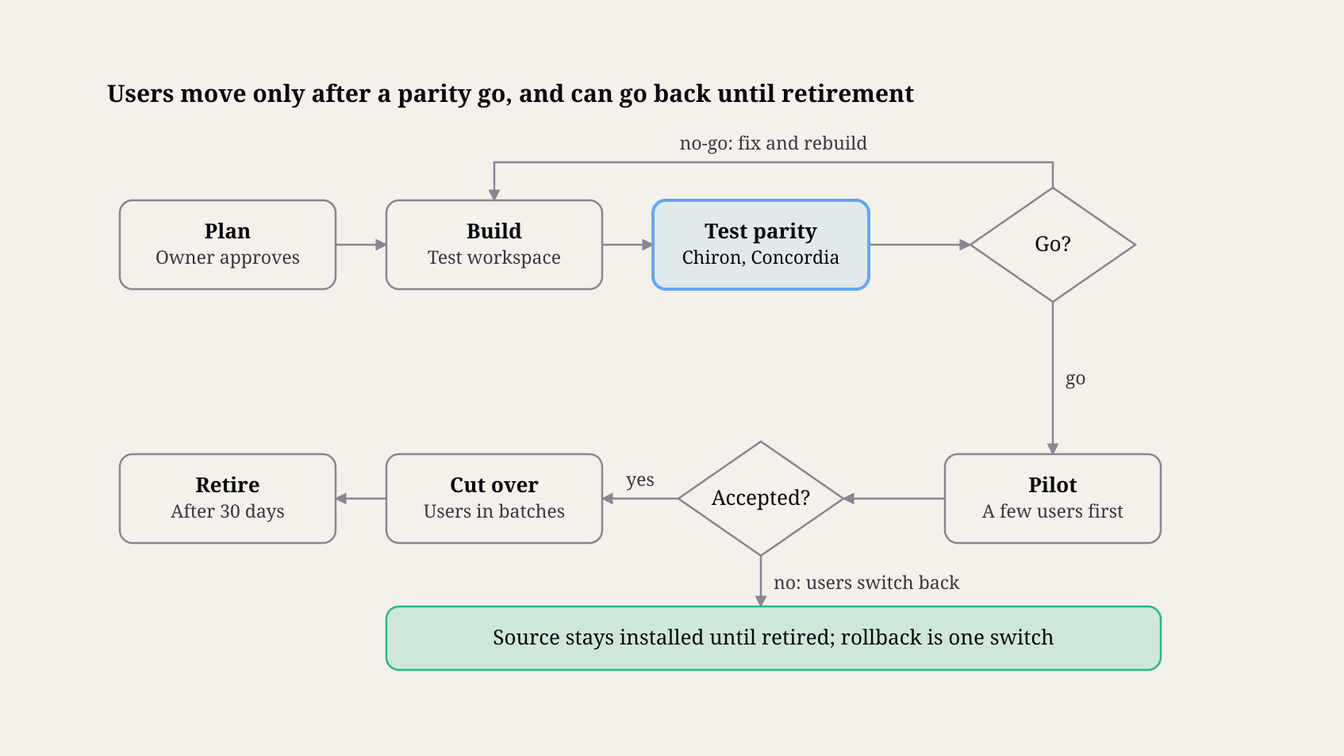
In Greek mythology, the Pleiades are seven sisters, the daughters of Atlas, who were set among the stars. They cross the night sky together as one cluster, and ancient farmers and sailors timed their seasons by them. ETM Pleiades keeps a company's agents together, whichever system they move to.
Your company's intent, carried into daily work
Keeps your people and your AI systems aligned on the same goals, plans, and decisions.
Facilitate alignment of organizational goals, strategies, decisions, accountability, ethics, and cultural principles across multiple agentic systems.
As AI systems take on more work, a company gains more actors making and shaping its decisions. Goals change, plans slip and policies are updated, yet the agents doing the work often still follow last quarter's instructions.
Misalignment rarely announces itself: a project that serves no goal, a discount above someone's authority, a customer promise that depends on a slipping release. By the time you see it in the results, the cost has already been paid.
Concordia keeps your goals, strategies, plans, decision rights and principles in one current record that your company owns, and delivers them to every AI system you use. It checks work and decisions against that record whenever either changes.
When something drifts out of line, the right owner hears about it, with the evidence and a suggested fix. Before an agent or workflow takes a consequential action, such as offering a discount, Concordia can check that it is allowed. Your people stay in charge of what the company intends.
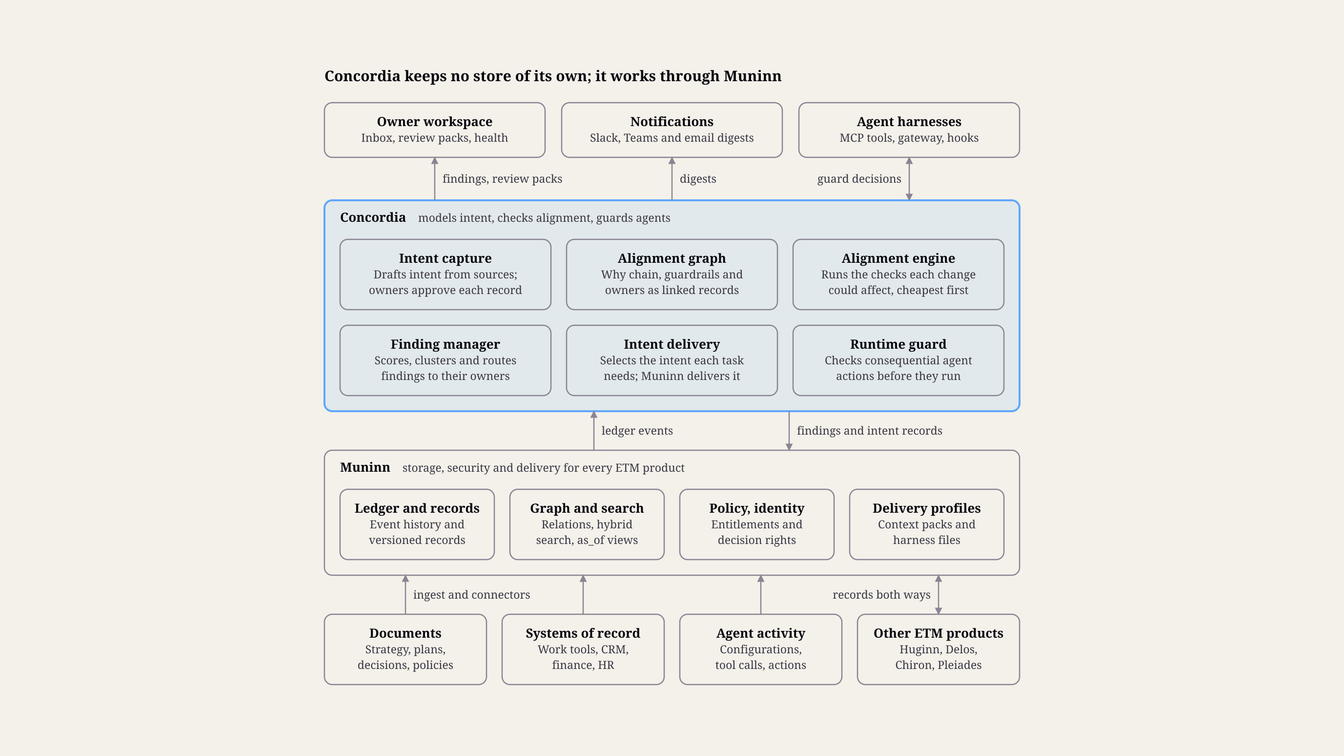
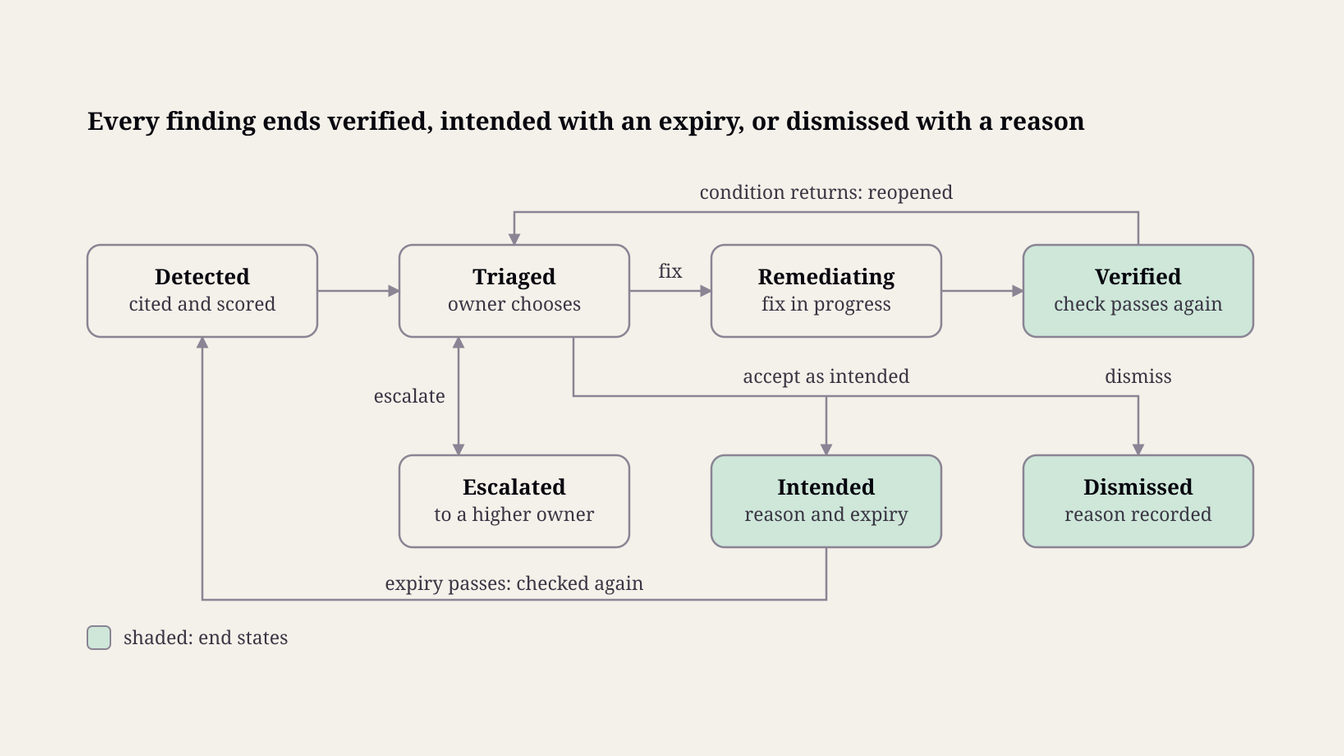
In Roman religion, Concordia is the goddess of agreement, and her name comes from the Latin for "hearts together." Her temple in the Roman Forum sometimes hosted the Senate as it settled matters of state. ETM Concordia keeps a company's people and AI systems of one mind.
Your company's AI, tested before it is trusted
Test each new AI system before you trust it, so changes don't break what works.
Regression testing and evaluations for multiple agentic systems.
AI systems change all the time, and not only when you choose to change them. Vendors improve the models behind their products on their own schedules, while teams edit prompts, add tools and bring in new systems.
Each change can quietly break something that worked yesterday. Generic benchmarks say little about a company's own tasks, so the first sign of trouble is often a customer complaint, a wrong quote or a policy breach.
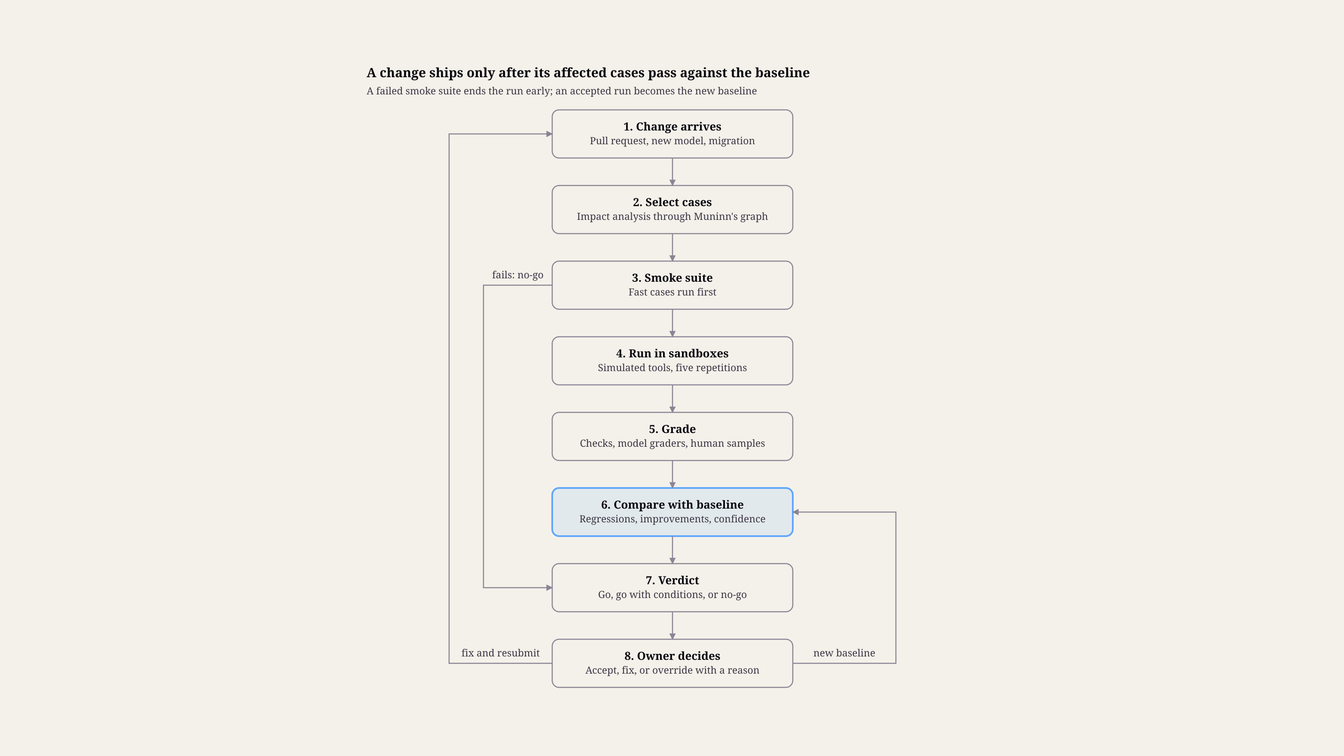
Chiron keeps tests built from your company's own work: its policies, procedures, past successes and past failures. Whenever an agent, workflow, model, prompt or tool changes, Chiron runs the tests that change could affect, safely away from live systems.
It compares the results with the last version you trusted. You get a clear verdict with the evidence behind it: go, go with conditions or no-go. Every failure becomes a new test, so the same problem cannot quietly return.
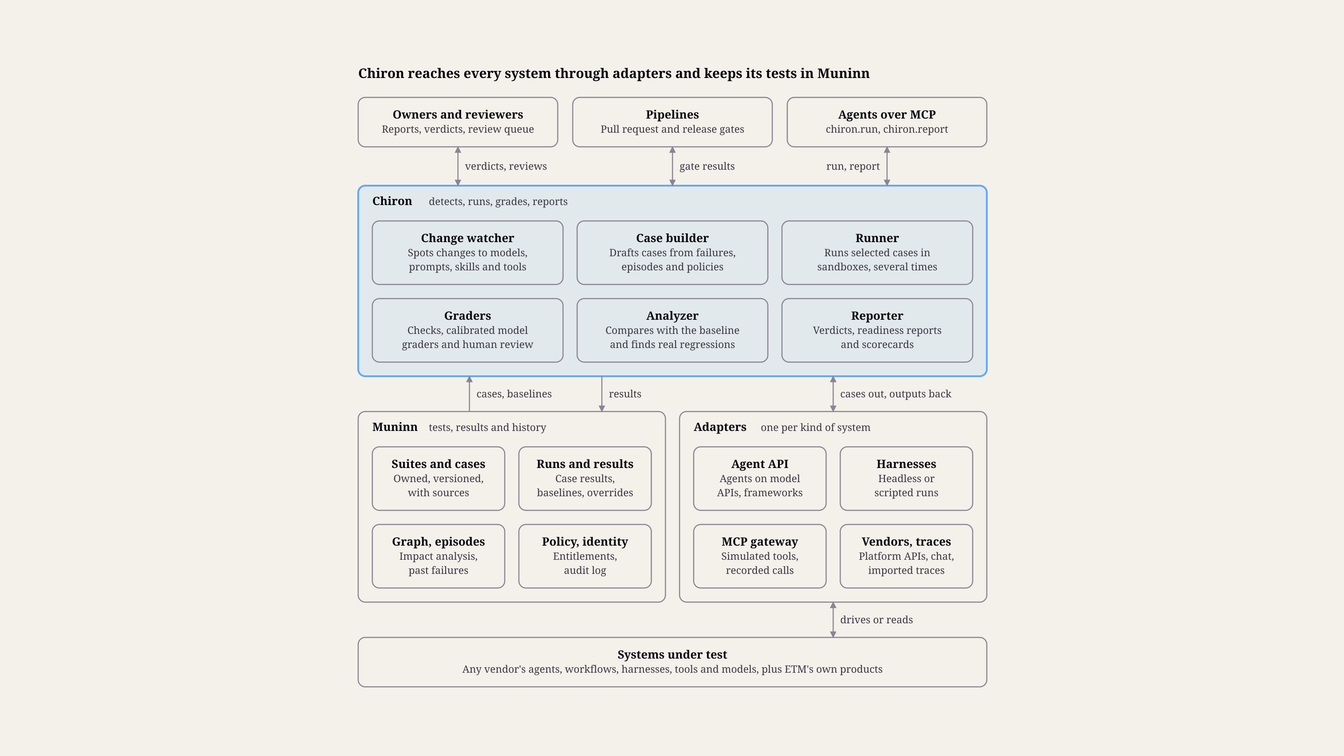
In Greek mythology, Chiron is the wise centaur who trained heroes, among them Achilles, Jason and the healer Asclepius. Homer calls him the most just of the centaurs. ETM Chiron gives each AI change a fair test on a company's own work before anyone relies on it.
Links outcomes to their causes, so every result teaches your organization how to improve.
Most companies can see what happened: revenue dipped, churn rose, a campaign "worked." Far fewer know why, or what will happen next if they change course. Dashboards show what moved together, so the next budget, price, or hire gets decided on a story instead of a cause.
Delos keeps a causal model of how your business works: the decisions you make, the factors that change as a result, and the outcomes you care about. It uses that model in two ways.
Your people stay in charge of the decisions.
The method behind Delos is the Growth Budget Model.
A causal model fits the decision in front of you. Each example below can be used in both directions:
In Greek mythology, the island of Delos is where Apollo was born, a place where things begin. ETM Delos traces each result back to where it began.